
Love
THE VIRTUE SERIES | Part Four of Six | The Virtue Nobody Told You Was a Choice

THE ARETE PATH LIBRARY
THE VIRTUE SERIES | Part Four of Six
There is a moment — and if you have loved anyone for long enough, you know exactly the one I mean — when the feeling stops.
Not forever. Not dramatically. Not with a door slam or a revelation or a betrayal. Just... quietly. Like a tide going out. You wake up on an ordinary Tuesday and the person beside you is the same person who once made your chest ache just by walking into a room, and today they are just... there. Breathing. Taking up their half of the bed. Leaving the coffee cup in the same wrong place they have left it every morning for the last eleven years.
And somewhere between the alarm and the shower, a thought arrives — uninvited, unwelcome, and so quiet you almost miss it:
Is this still love?
The world has an answer for that question. The movies have an answer. The songs have an answer. The romance novels and the wedding speeches and the entire billion-dollar industry built on the assumption that love is a feeling have an answer, and it is this: if you don’t feel it, it’s gone. Move on. Find someone who makes you feel it again. Because love is a fire, and if the fire dies, what’s left is just... staying.
And that answer — that confident, seductive, deeply destructive answer — is the biggest lie the modern world tells about the most important thing in human life.
Because love is not a fire.
Love is a choice. Made daily. Made quietly. Made on the mornings when the feeling is a bonfire and on the mornings when the feeling is an ember and on the mornings when the feeling is ash and you choose it anyway.
You don’t fall in love. You choose it. The fall is choosing it again tomorrow.
Those six words — you don’t fall in love — might be the most countercultural thing in this entire series. Because every song you’ve ever heard, every film you’ve ever watched, every fairy tale you were told as a child, taught you the opposite. They taught you that love arrives. That it happens to you. That it sweeps you off your feet — as though your feet were the problem, as though standing on your own solid ground was something love was supposed to rescue you from.
It wasn’t. It isn’t. Love is not a rescue. Love is a practice. And the difference between those two things is the difference between a relationship that collapses the moment the feeling fades and a relationship that is still standing, still warm, still lit from within, forty years later — not because the feeling never left, but because two people decided, on the mornings when it did, to choose each other anyway.
───────────
The Lie We Were Told About Love
We were told love is something you fall into.
Think about that word. Fall. You don’t choose to fall. You don’t plan a fall. Falling is what happens when the ground disappears — it is loss of control dressed up as romance. And we built our entire understanding of the most important human experience around a word that means losing your footing.
No wonder so many relationships don’t survive the first real winter. They were built on a feeling that, by its own definition, was never in your hands.
The fairy tale goes like this: you meet someone. Something happens — chemistry, attraction, a look across a room, a conversation that makes time disappear. The feeling arrives, enormous and uninvited, and suddenly everything is different. Colours are brighter. Songs make sense. The world rearranges itself around this person and you think: this must be love, because nothing has ever felt like this.
And you’re right. It is something. It is real. It is powerful and beautiful and important and it deserves to be honoured.
But it is not love. It is the invitation to love.
It is the door. Not the house. And most people spend their lives running from door to door, mistaking the thrill of the entrance for the thing itself — never staying long enough to see what’s inside. Never sitting in the quiet room behind the door, where the real thing lives, because the quiet room does not feel like the doorway. The quiet room feels like Tuesday.
Erich Fromm saw this with painful clarity over half a century ago:
“Love is not something natural. Rather it requires discipline, concentration, patience, faith, and the overcoming of narcissism. It isn’t a feeling, it is a practice.” — Erich Fromm, The Art of Loving
Read that list. Discipline. Concentration. Patience. Faith. The overcoming of narcissism. Does that sound like falling? Does that sound like something that happens to you while violins play in the background? That sounds like work. Beautiful, sacred, life-defining work — but work. The kind nobody warned you about because the warning doesn’t sell tickets.
───────────
What It Actually Looks Like
Real love — love as a virtue, love as a practice, love as a daily choice rather than a recurring feeling — looks nothing like the movies. It looks like your life. Right now. In the quiet rooms nobody films.
It looks like a man who has been married for twenty-three years, sitting on the edge of the bed at 6am, looking at his wife while she sleeps. She does not look like she looked on their wedding day. Neither does he. The electricity of the early days is a memory — a warm one, a good one, but a memory. What replaced it is something the early days could never have produced: a knowing. He knows her. Not the version she shows the world — the real one. The one who is afraid of being forgotten. The one who cries at the dog food commercial. The one who cannot sleep without the fan on even in winter. He knows her in the way you know a house you have lived in for decades — every creaking board, every sticking window, every patch of light that falls across the floor at a certain time of day. And this knowing — this unglamorous, unsexy, completely uncinematic knowing — is more intimate than anything the early days could have dreamed.
He gets up. He makes the coffee. He makes it the way she likes it, not the way he likes it, because he learned the difference fifteen years ago and has been choosing her way every morning since. Nobody is watching. Nobody will applaud this. It will never be a grand gesture. It will never be a story he tells at a dinner party.
It is love. The realest kind. The kind that is built not in the moments that take your breath away, but in the ten thousand mornings when you choose to make the coffee.
It looks like a woman standing in a hospital corridor. Her mother is on the other side of that door — smaller now, confused sometimes, a version of the fierce, brilliant woman who raised her that she was not prepared to meet. The doctors have said what they needed to say. The pamphlets have been read. The decisions that no child should have to make about a parent have been made, and they sit in her stomach like stones.
She pushes the door open. She sits down. She takes her mother’s hand — a hand that once braided her hair, once packed her school lunches, once held her face after a nightmare and said nothing because nothing needed to be said — and she holds it. Not because it will change anything. Not because her mother knows she is there, not today, not fully. But because love is not a transaction. Love is not: I will show up as long as you recognise me. Love is: I am here. Whether you know it or not. Whether it makes a difference or not. I am here.
Love is not a feeling you find. It is a promise you keep — on the days it’s easy and on the days it takes everything you have.
It looks like two old friends meeting for coffee after a silence that lasted too long. Something happened — not a fight, not a falling out, just the slow drift of lives moving in different directions. Kids. Jobs. Cities. The comfortable lie that you’ll catch up soon, repeated until soon becomes months becomes years. And one of them picks up the phone. Not because the feeling of friendship was burning in their chest. Because they chose to. Because love — and friendship is love, make no mistake — is not sustained by feeling. It is sustained by the person who reaches out when the reaching is inconvenient.
It looks like a father at his son’s football game, standing on the sideline in the rain, watching a team that is losing badly, watching his boy struggle, watching the thing his child cares most about in the world go wrong in real time. And he stays. He doesn’t check his phone. He doesn’t leave at half time. He stands in the rain, fully present, fully there, because his son will look up at the sideline at some point during the second half — they always look up — and what he will see is his father. Still there. Wet and smiling and not going anywhere.
That look — the one the boy gives when he sees his dad hasn’t left — is worth more than a hundred I love yous. Because that look is not about words. It is about evidence. It is the child’s nervous system receiving the data it needs more than any other data in the world: you stayed.
───────────
Love Is a Verb
The Greeks — who seemed to understand everything about the human heart two thousand years before we reinvented the conversation — had multiple words for love. Not one. Several. Because they understood that love is not a single experience. It is a family of experiences, each one different, each one necessary, each one demanding something specific from you.
They spoke of eros — the fire, the passion, the love that starts in the body and floods the mind. This is the one the movies sell. This is the door.
They spoke of philia — the love of deep friendship, of shared history, of two people who have walked enough road together that they no longer need to explain themselves. This is the two old friends at the coffee shop.
They spoke of storge — the love of family, the love that is not chosen so much as inherited, the love between parent and child that exists before the child even has a name. This is the father in the rain.
And they spoke of agape — the highest form. Unconditional love. The love that says: there is no version of you I will not love. No failure, no distance, no silence, no season of difficulty will make me leave. This is the woman in the hospital corridor. This is the man making the coffee at 6am.
Agape is the love that most of us want and almost none of us have been taught to practise. Because it requires something that the modern world does not value: staying.
Staying when the feeling has left the building. Staying when the person you love is not being loveable. Staying when the door of someone new and exciting is standing open and the quiet room of the person you’ve chosen looks, for a moment, like a prison rather than a home.
Corinthians — whether you are a person of faith or not — contains the most accurate job description of love ever written:
“Love is patient, love is kind. It does not envy, it does not boast, it is not proud. It is not easily angered, it keeps no record of wrongs.” — 1 Corinthians 13:4-5
Read that as a to-do list. Patient — today, not in theory. Kind — to this person, the one who left the coffee cup in the wrong place, not a hypothetical person who is easy to be kind to. Keeps no record of wrongs — which means the argument from last Thursday is over, fully over, not stored in a filing cabinet to be retrieved during the next argument.
That is not a feeling. That is a discipline. A daily, chosen, practised discipline of the heart.
───────────
The Lavender and the Book
The symbol of Love on The Arete Path is not a heart. It is not a ring. It is not a rose.
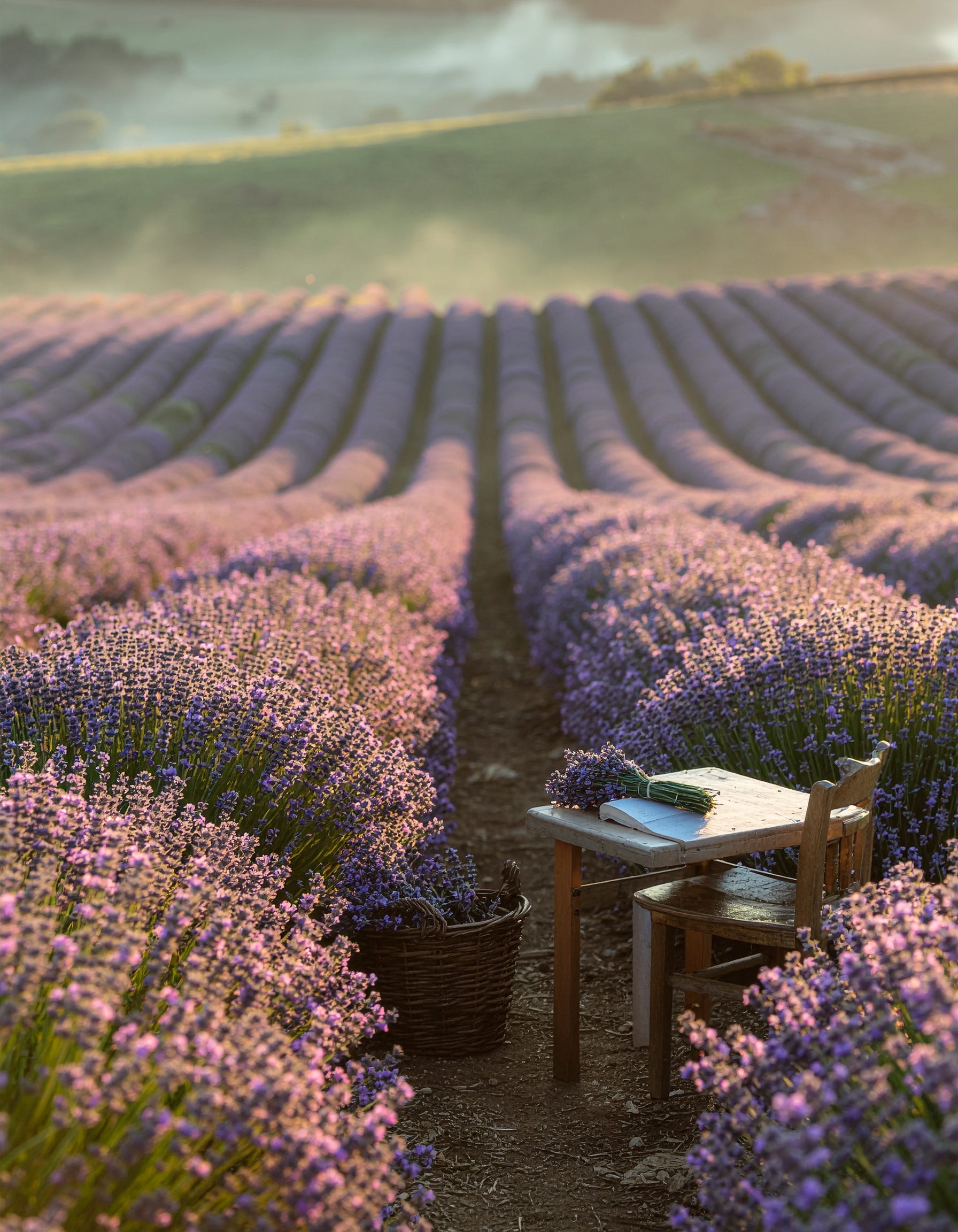
It is lavender and a book.
And there is a reason for that, and the reason will matter to you if you sit with it.
Lavender is one of the most resilient plants on earth. It grows in poor soil. It thrives in drought. It does not need pampering or perfect conditions — it needs sunlight and time. Leave it alone and it will fill an entire hillside. Cut it back hard and it grows back stronger. Press it between the pages of a book and it holds its fragrance for years — long after the bloom has dried, long after the colour has faded, the scent remains.
That is love. Not the hothouse flower that needs constant attention and perfect conditions and collapses the moment the temperature drops. The plant that grows in difficult soil. The fragrance that endures after the bloom.
And the book is the record. The story you are writing together — not the story you planned, not the story the fairy tale promised, but the real story. The one with chapters you’d rather skip and chapters that make you weep with gratitude. The one with margins full of notes and corrections and the occasional page that is stained with something you spilled while you were living it.
Rumi — who understood love as deeply as any human being ever has — wrote:
“Your task is not to seek for love, but merely to seek and find all the barriers within yourself that you have built against it.” — Rumi
The barriers. Not the feeling. Not the person. The barriers within yourself — the fear of being known, the habit of keeping score, the refusal to be vulnerable because the last time you were vulnerable someone used it against you. Those are the weeds in the lavender field. And love — real love, the chosen kind — is the daily work of pulling them up so the plant can grow.
───────────
Love in the Hard Season
Every love will face a winter. Every single one. The winter of distance. The winter of boredom. The winter of the terrible thing that was said that hasn’t fully healed. The winter of the illness, the job loss, the grief that moved into the house and stayed longer than anyone expected. The winter of looking at each other across the kitchen and not knowing what to say.
Most loves die in winter. Not because the love itself has gone — but because both people are waiting for the other one to bring the spring. Both are standing in the cold room, arms folded, waiting to feel it again before they act.
And the love that survives winter — the love that is still there on the other side, stronger and quieter and more real than anything the summer version could have imagined — is always the one where somebody chose first.
Somebody made the coffee without being asked. Somebody reached across the bed in the dark and placed a hand on the other person’s back, not to initiate anything, not to fix anything, just to say: I’m here. I know it’s cold. I’m not going anywhere.
Somebody chose love before they felt it. And the feeling followed. It always follows. Not immediately. Not on your schedule. But it follows — the way spring follows winter, not because anyone earns it, but because that is what happens when you stay in the field long enough.
Viktor Frankl — a man who survived the unsurvivable and spent the rest of his life writing about what makes human beings endure — said something about love that should be engraved on every wedding ring and every doorframe and every mirror where someone stands in the morning wondering if this is still enough:
“The salvation of man is through love and in love.” — Viktor Frankl, Man’s Search for Meaning
Through love and in love. Not through the feeling of love. Through the act of it. Through the daily, unglamorous, teeth-gritting-sometimes practice of choosing another person when every impulse says protect yourself.
That is what salvation looks like. Not a single heroic moment. A thousand quiet ones. A thousand coffees. A thousand hands on backs in the dark. A thousand mornings of choosing it again.
───────────
Every Room Love Lives In
This essay has spoken about romantic love, because that is where the lie lives loudest. But if Love is a virtue — and it is, it is one of the most demanding of all six — then it does not live in one room of your life. It lives in every room. And in every room, it asks the same question: will you choose me today?
The answer changes shape depending on the room. But the cost is always the same. Love costs you the easier option.
A Parent’s Love
It is 3am and there is a small body in your bed again. She had the nightmare — the one she can’t describe, the one with the thing in the cupboard that doesn’t have a name. She is four years old and she is trembling and she has wedged herself between you and the edge of the mattress with an elbow in your ribs and a foot against your spine and you have to be up in three hours and you are so tired you could weep.
And you pull her closer. Not because it is convenient. Not because sleep doesn’t matter. Because she is afraid and you are the answer to that fear — not with words, not with logic, not with a lecture about how there is nothing in the cupboard. With your body. With your warmth. With the steady rhythm of your breathing that says, without a single word: I am here. Nothing can get you while I am here.
That is love. The 3am kind. The kind that costs you sleep you cannot afford and gives you something no amount of sleep could.
Fast forward ten years. She is fourteen. She does not want to be in your bed. She does not want to be in the same room as you. She is a stranger who lives in your house and communicates primarily in monosyllables and eye rolls and the occasional door slam that rattles the picture frames in the hallway.
And the thing in the cupboard has changed. It is not imaginary anymore. It is the friend group that turned on her. It is the boy who said something cruel. It is the body she is growing into that doesn’t match the one she sees on her phone. And she won’t tell you. She won’t let you in. She has locked the door of her room the way she used to climb into your bed — not because she doesn’t need you, but because needing you feels dangerous now, and independence is the armour she is learning to wear.
And you love her. You love her by leaving the light on in the hallway. By making the sandwich she didn’t ask for. By saying goodnight through a closed door and meaning it even when nothing comes back. By resisting — with every fibre of your body — the urge to force the door open, to fix it, to make her be four again when everything was simpler and she fit between your ribs and the edge of the mattress.
That is love. The fourteen-year-old kind. The kind that costs you control and gives you something harder and more valuable: trust.
Fast forward again. She is thirty-two. She lives in another city. She calls on Sundays — sometimes. She has a life you didn’t build and a partner you didn’t choose and opinions about things you didn’t teach her. She is, in the most beautiful and painful sense of the word, her own person.
And you love her by letting her be.
By not correcting the decision you think is wrong. By biting your tongue when the advice is sitting right there, perfectly formed, desperate to be delivered. By saying how are you and meaning it, and listening to the answer without trying to fix what you hear. By trusting — with everything you’ve built across thirty-two years of 3am nightmares and slammed doors and sandwiches left outside closed rooms — that the foundation holds. That the love you poured in is still there, even when you can’t see it, even when she doesn’t say it, even when the call on Sunday doesn’t come.
A parent’s love is the longest act of faith a human being will ever perform — believing in something you built, long after you’ve stopped being able to see it.
───────────
A Child’s Love
We talk about a parent’s love as though it is the harder one. It isn’t. Or rather — it is hard in a different direction.
A child’s love is hard because it has to survive the discovery that your parents are human.
There is a moment in every person’s life — and you remember yours, even if you have never spoken about it — when you looked at your mother or your father and saw, for the first time, not the giant, not the hero, not the unshakeable force that had always been there, but a person. A tired, uncertain, imperfect person who was doing their best with tools they had inherited from their own tired, uncertain, imperfect parents.
That moment is a kind of grief. The grief of realising that the people you loved as gods are mortal. That they made mistakes — some of them serious, some of them still living in rooms in your mansion with the light on. That the love they gave you, fierce and real and well-intentioned as it was, came with dents and scratches and blind spots that you are still, decades later, learning to see.
And the choice — the love choice — is what you do with that discovery.
You can harden. You can catalogue the mistakes. You can hold the ledger up and say: you fell short here, and here, and here. And you would not be wrong. The ledger is real. The dents are real.
Or you can do something much harder and much more beautiful. You can look at the person who raised you — the one who got it wrong sometimes, the one who shouted when they should have whispered, the one who didn’t know how to say I love you because nobody ever said it to them — and you can choose to love them anyway. Not because they were perfect. Because they were there. Because they showed up. Because they made the coffee. Because they stood in the rain at the football game, even if they got a hundred other things wrong.
A child’s love is the grace of seeing your parents clearly — every flaw, every failure, every unhealed wound — and choosing to love the human being, not the version you needed them to be.
That grace is not automatic. It is not owed. It is chosen. And sometimes it takes a lifetime to get there. But the people who do — the ones who find a way to love their parents as humans rather than as heroes or villains — carry a freedom that the ones who don’t will spend their lives searching for.
───────────
A Friend’s Love
There is a kind of love that the world does not take seriously enough, and it is this one.
It is a Tuesday night and your phone rings. The name on the screen belongs to someone you haven’t spoken to in three months — not because anything went wrong, but because life did what life does. It filled every gap. It consumed every margin. The friendship didn’t end. It just got quieter, the way a song fades when you drive out of range of the radio station — still playing, somewhere, but you can’t hear it anymore.
You answer. And within forty-five seconds, it is as though no time has passed at all. The voice is the same. The laugh is the same. The way they say your name — the particular emphasis, the warmth that lives in a single syllable — is the same. And something in your chest that you didn’t know was clenched gently unclenches.
That is friendship love. And it is one of the most undervalued forces in human life.
Because friendship love is the love you choose with nothing at stake. No contract. No vow. No biological imperative. No shared mortgage or custody agreement or legal consequence for walking away. You stay in a friendship for one reason only: because you want to. Because this person sees you — not the version you perform for the world, not the curated highlight reel, but the you who is afraid and uncertain and a bit of a mess sometimes — and they stay anyway. And you see them the same way. And neither of you flinches.
It looks like the friend who drives forty minutes to sit in your kitchen after the phone call that changed everything — not to fix it, not to offer solutions, just to be in the room. To make the tea. To sit in the silence with you, because the silence of someone who loves you is different from the silence of being alone, and you both know it.
It looks like the friend who tells you the truth when the truth is hard. Who says, gently but clearly: I think you’re making a mistake. Not because they want to be right. Because they love you more than they love your approval. And that — the willingness to risk the friendship in service of the friend — is one of the bravest forms of love there is.
Friendship is the love you practise with no safety net. No contract holds it together. Only the choice, made again and again, to show up.
───────────
Loving Yourself
And then there is this one. The one most people skip. The one that feels indulgent to even mention, because the world has taught you that loving yourself is either narcissism or a luxury you haven’t earned yet.
It is neither.
Loving yourself is the foundation that every other form of love stands on. And most of us are trying to pour from a cup we have never filled.
Here is what self-love actually looks like. Not the bubble bath version. Not the treat yourself version. The real one.
It looks like the woman who catches herself in the mirror after a shower and, for the first time in as long as she can remember, does not immediately catalogue what is wrong. Who looks at the body that has carried her through every storm in this series — through the 3am nightmares and the slammed doors and the hospital corridors and the cemetery in the rain — and says, quietly, without performance: thank you. You carried me. I am sorry I have spent so many years at war with you.
It looks like the man who finally says no to the extra commitment — not because he doesn’t care, but because he has learned, the hard way, that a person who says yes to everything is a person who has said no to themselves so many times they’ve forgotten what their own voice sounds like.
It looks like the person who goes to therapy. Not because they are broken. Because they have decided that the way they talk to themselves — the voice inside their head that is harsher than any voice they would use on a stranger — deserves to be examined. Challenged. Replaced with something kinder.
Thich Nhat Hanh — who lived a life of such gentle, consistent, chosen love that it became impossible to separate the man from the practice — said:
“To love without knowing how to love wounds the person we love.” — Thich Nhat Hanh
That includes you. If you do not know how to love yourself — if the only voice in your head is the critic, if rest feels like laziness and kindness toward yourself feels like weakness — then every other love you practise will carry that wound into the room. You will love your partner from a place of depletion. You will love your children from a place of exhaustion. You will love your friends from a place of guilt. And none of them will get the version of you that you are actually capable of being.
Self-love is not selfish. It is structural. It is the cup that must be filled before anything can be poured.
And it is a choice. The same choice as every other love in this essay. Made daily. Made on the mornings when you don’t feel worthy of it. Made especially then.
───────────
How They All Coexist
Here is the thing about love that nobody prepares you for: you are practising all of it at the same time.
On any given Tuesday, you are the partner choosing to make the coffee. You are the parent leaving the light on in the hallway. You are the child learning to see your mother as a person. You are the friend who should pick up the phone. And you are the human being who hasn’t said a kind word to themselves in three weeks.
All of it. At once. Every day. And the conductor — remember Temperance? — is trying to give each one its proper volume, its proper moment, its proper care.
Some days one love will need more than the others. The child is sick and the partner waits. The friendship is in crisis and the self-care gets postponed. The parent needs you and the routine falls apart. That is not failure. That is the orchestra responding to the music of the moment.
But here is what matters: none of them can go silent forever. An instrument that stops playing doesn’t just go quiet — it goes out of tune. And bringing it back takes longer than it would have taken to let it play a few notes along the way.
Love your partner. Love your children. Love your parents — as they are, not as you needed them to be. Love your friends. And love yourself — not last, not with what’s left over, but with the same deliberate, daily, chosen care you give to everyone else.
Love is not one thing. It is every room in your house, lit from within, each one asking the same question: will you choose me today?
To love without knowing how to love. That is the sentence that should keep us all awake. Because most of us are loving with tools we inherited from people who were also loving without knowing how. And the chain continues — imperfect love teaching imperfect love — until someone stops and says: I want to learn. I want to love better. Not perfectly. Better.
That willingness — that single, humble, brave willingness — is the beginning of everything this virtue asks of you.
───────────
What Love Needs Beneath It
Love does not stand alone. It never has. It needs the three virtues that came before it — and without them, it collapses into something that looks like love but doesn’t last.
It needs Fortitude — because love will be tested. The commitment you make on the good day will be audited on the worst day. And without roots, without the capacity to stand firm when every instinct says walk away, love becomes conditional. I will love you as long as it’s easy. That is not love. That is a lease.
It needs Temperance — because love that has no balance consumes everything. The parent who loves so fiercely they smother. The partner who loves so desperately they lose themselves. Love without temperance is an orchestra with every instrument at maximum — not music, noise. Love conducted with balance gives each person space to breathe, to grow, to be themselves within the shelter of something shared.
It needs Wisdom — because love without understanding is blind devotion, and blind devotion has never saved anyone. Wisdom is the gold panner’s eye — the ability to look at the mud of a relationship honestly and say: this is what is real. This is what needs work. This is the gold. And this is the sediment I need to let go of. Without wisdom, love repeats its mistakes forever, calling the repetition commitment when it is actually fear.
Love without roots blows away. Love without rhythm burns out. Love without sight walks in circles. Love with all three walks forward — slowly, imperfectly, beautifully — into something that lasts.
───────────
The Stone
The stone of Love is Rhodochrosite.
It is pink — but not the sharp, synthetic pink of a greeting card. It is the pink of sunrise through winter clouds. Soft. Layered. Warm in a way that surprises you, because you expected pink to feel delicate and this feels strong. Bands of rose and cream ripple through the stone like the rings of a tree — record of time, evidence of growth, proof that something beautiful was built slowly, layer by layer.
In many traditions, Rhodochrosite is the stone of the compassionate heart. It is carried not by people who have never been hurt, but by people who have been hurt and chose to stay open. That distinction matters. Anyone can love before the wound. The stone honours the person who loves after it.
Rhodochrosite. Soft. Strong. Layered with time. The stone you hold when you need to remember: love is not what you feel. It is what you choose.
Six Stones Project by Arete Estate — Coming Soon
───────────
Tonight
There is someone in your life right now that you love. Not the easy love — the complicated kind. The kind that has been through at least one winter and maybe more. The kind that has left the coffee cup in the wrong place so many times you’ve stopped counting. The kind that has said the wrong thing and done the wrong thing and been imperfectly, frustratingly, beautifully human in your presence for long enough that the fairy tale has well and truly worn off.
And you are reading this tonight, which means something in you is still burning. Something in you — beneath the exhaustion, beneath the frustration, beneath the quiet distance that has grown between you and this person like ivy between bricks — still believes that what you have is worth the work.
It is.
So tonight, I am not going to ask you to rekindle anything. I am not going to suggest a date night or a conversation framework or a five-step plan for falling back in love.
I am going to ask you to do one thing. The smallest thing. The thing that means the most.
Choose them.
Not because they deserve it tonight — maybe they don’t. Not because you feel it tonight — maybe you don’t. Choose them because that is what love actually is. The choosing. The returning. The act of walking back into the quiet room when every door in the building is open and saying: this is the one. This is the room I built. This is the person I chose. And I choose them again tonight.
Make the coffee. Reach across the bed. Send the text. Sit on the sideline in the rain. Hold the hand that doesn’t hold back. Show up for the person who has stopped expecting you to.
Not because it will fix everything. Because it will mean everything.
You don’t fall in love. You choose it. The fall is choosing it again tomorrow.
Choose it tonight.
And tomorrow morning, when the alarm goes off and the person beside you is just... there — breathing, familiar, imperfect, yours — choose it again.
That is Love. The fourth virtue. The one that makes all the others worth practising.
And it is, without question, the bravest thing you will ever do.
───────────
The Invitation
This essay is the fourth in a series of six — one for each virtue on The Arete Path. Fortitude laid the roots. Temperance found the rhythm. Wisdom saw the gold in the mud. Love — the one you just read — is the choice that makes the other three worth having.
Next comes Courage — the windmill that faces the wind and uses it. And then Gratitude — the virtue that changes what you see, not what is there.
If this piece found you tonight — if you saw yourself in the coffee cup, the hospital corridor, the sideline in the rain, or the quiet room behind the door — then you already understand what we are building.
Subscribe to The Arete Path Library on Substack. The next virtue — Courage — arrives soon. The lavender is growing.
───────────
Marcus J Emsley is the founder of Arete Estate, a philosophy-based character formation company based in the Barossa Valley, South Australia. Built on 17 years as a welfare specialist in the Australian Defence Force, Arete Estate exists to help people discover, develop, and demonstrate the six classical virtues — Fortitude, Temperance, Wisdom, Love, Courage, and Gratitude — through coaching, storytelling, and education.
The Arete Path. Excellence revealed BY storms.