
The Difference Between Values and Virtues (And Why It Changes Everything)
A distinction that quietly changed how I think about legacy.

I want to share something with you that shifted something in me when I first understood it. It’s a distinction — a simple one, really — but the kind that keeps working on you long after you first hear it.
It’s the difference between values and virtues.
We use these words almost interchangeably. But they’re not the same thing. And understanding the difference might open a door you didn’t know was there.
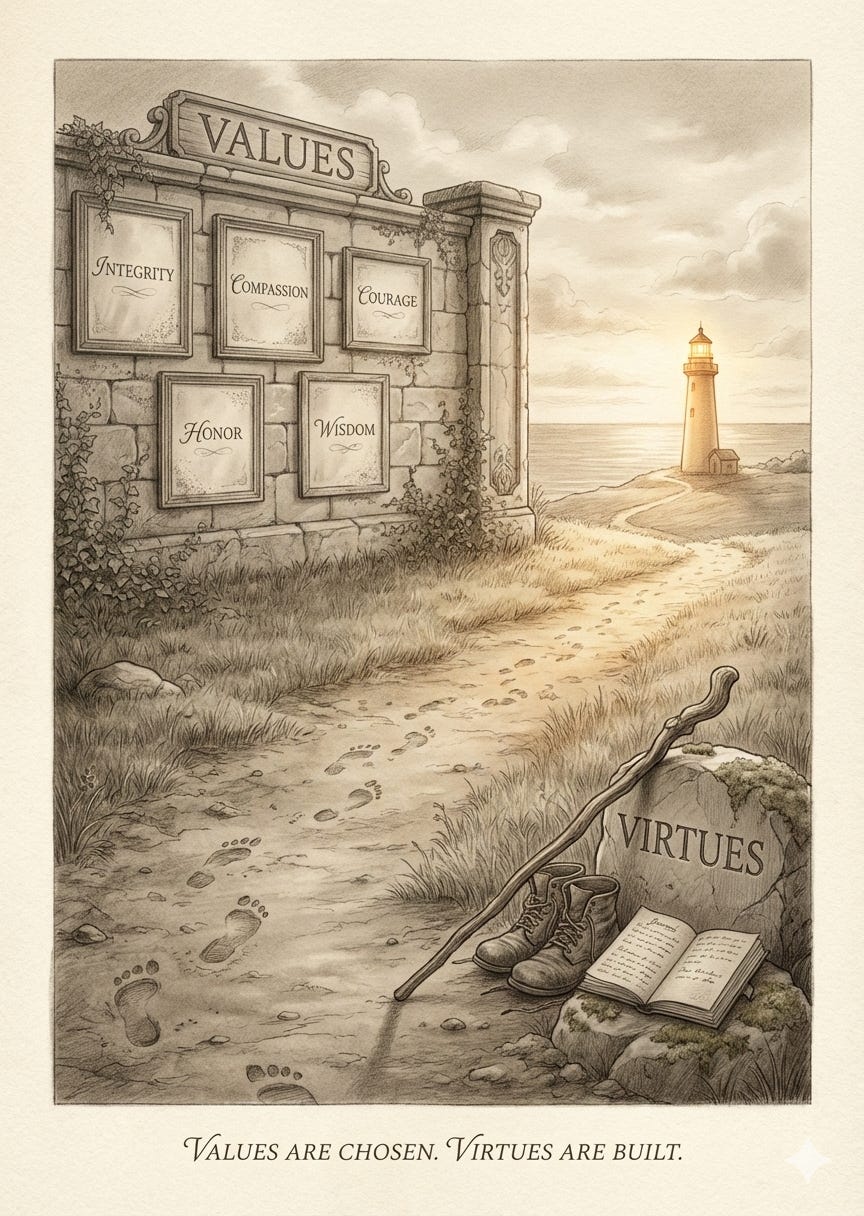
What’s a Value?
A value is something you believe is important.
Honesty. Courage. Family. Love. Integrity. You can name your values right now if someone asked you. Most of us can. They’re the principles we hold, the things we care about, the ideas that shape how we see the world.
Values are wonderful. They point us toward what matters. They give us language for our aspirations.
But here’s what I’ve come to understand: you can hold a value without ever living it.
Not because you’re a hypocrite. Not because you’re failing. But because values, by their nature, live in your head and your heart. They’re declarations. Intentions. Hopes for who you’d like to be.
And sometimes there’s a gap between who we’d like to be and who we actually are when the pressure is real.
What’s a Virtue?
A virtue is something different.
A virtue is a value that’s been practised — so many times, through so many moments, that it’s become part of who you are. Not just what you believe, but how you act. Not just in your head, but in your hands. In your habits. In your instinctive response when life doesn’t give you time to think.
The ancient Greeks had a word for this: arete. It’s often translated as virtue or excellence, but it really means the full realisation of what something is meant to be. A knife has arete when it cuts cleanly. A horse has arete when it runs with grace. A vine has arete when it produces beautiful fruit.
And a human being? We have arete when we’ve practised our values so deeply that they’ve become our character.
Aristotle understood how this works. We become courageous by doing courageous things. We become patient by practising patience. We become generous by giving — again and again — until generosity is simply what we do.
Values are chosen. Virtues are built.
Why This Matters
I’m sharing this because it reframed something for me.
For years, I thought the goal was to have good values. To believe the right things. To know what mattered. And I did know. I could name my values easily. But knowing them didn’t always mean living them — especially in the hard moments, the tired moments, the moments when no one was watching.
The shift came when I stopped asking “What do I value?” and started asking “What am I practising?”
Because practice is where values become virtues. It’s where intention becomes character. It’s the slow, quiet, daily work of closing the gap between who we say we are and who we’re actually becoming.
And here’s what gives me hope: the gap isn’t a verdict. It’s an invitation.
Every day is a chance to practise. Every small choice is a chisel-strike. You don’t have to be perfect — you just have to keep showing up, keep building, keep choosing who you want to become.
The Inheritance
This is what my novel Wisdom & Wine is really about.
On the surface, it’s the story of Donald, an elderly man who has one impossible afternoon to share his life’s wisdom with his granddaughter Sophia. He tells her six stories. Passes her six picture frames. Each one represents something he learned — fortitude, temperance, wisdom, love, courage, gratitude.
But what Donald passes to Sophia isn’t a list of values to believe in. It’s a legacy of virtues — practices that were lived, tested, refined across decades. Across generations.
He tells her about his father, a traumatised veteran who taught him to be the lighthouse: “The lighthouse doesn’t try to stop the storm. It can’t. But it can shine. It can stand firm and shine so that ships in the darkness have something to steer toward.”
His father didn’t just believe in fortitude. He practised standing firm — so many times that steadiness became who he was. And that’s why he could pass it on. Not as words, but as proof. Not as a lecture, but as a lived example his son could inherit.
That’s the beautiful thing about virtues: they can be passed down. Values are personal — they live and die with you. But virtues, once built, become a gift you can leave behind. A shelter others can stand in. A light they can steer toward.
The Path
This is what we’re building at Arete Estate.
Not a list of values for you to adopt. A path for building virtues you can embody — and one day, pass on.
The six virtues of The Arete Path — Fortitude, Temperance, Wisdom, Love, Courage, and Gratitude — aren’t ideas to admire. They’re practices to live. Daily rhythms. Repeated choices. The slow, patient work of becoming who you were meant to be.
We call it The Arete Path because the path is the point. Not the destination. Not some future version of yourself you’re trying to reach. But the walking itself. The daily practice. The showing up, again and again, until the practice becomes the person.
You are both the sculptor and the marble. Every day, with every choice, you’re shaping something. And the beautiful news is: you get to choose what you’re shaping.
An Invitation
So here’s what I’d leave you with. Not a challenge. Not a lecture. Just an invitation to sit with a question:
What would it look like to practise one of your values today?
Not perfectly. Not dramatically. Just one small action that closes the gap — even slightly — between what you believe and who you’re becoming.
If you value patience, what would it look like to practise it in one conversation today?
If you value courage, what’s one small brave thing you could do before the day ends?
If you value love, who could you choose today — even when choosing is inconvenient?
Values are the blueprint. Virtues are the building. And you don’t build all at once. You build one brick at a time. One choice at a time. One ordinary, unremarkable day at a time.
That’s the path. That’s the invitation.
And if you’d like to walk it with others — with a community of people doing this same quiet work — that’s what The Arete Path is for. Not to lecture you. Not to fix you. Just to walk beside you while you build.
Excellence is revealed by storms, not despite them.
But you don’t have to wait for the storm to start building.
You can start today.
Good luck!
Contact me.
Instagram - https://www.instagram.com/areteestate?igsh=ZjVrY3d5MnBrZDJz&utm_source=qr
Email - marcus@areteestate.com.au
Marcus J Emsley is the founder of Arete Estate and author of Wisdom & Wine. He writes about character, resilience, and the slow art of becoming. If this landed for you, you’re welcome here — and more importantly, you’re capable of more than you know.